What you'll need
Pints per day tells you how much water a dehumidifier can remove from the air in 24 hours under a defined laboratory condition. It does not tell you the bucket size, how long the bucket will last in your room, or whether the unit can pump water uphill.
Use the pint rating to choose moisture-removal capacity. Make the bucket, gravity-drain, or pump decision separately.
Pints per day calculator: old label to new label, and room size
Two quick checks. The first turns an old pre-2019 pints-per-day label into the approximate current label. The second gives ENERGY STAR's pints-per-day band for your room size and dampness. Both are starting points, and the tables below show every number the tool uses.
1. Old label to new label
Enter an old label to see the approximate current label.
2. Room size and dampness
Old-to-new label table (ENERGY STAR)
| Old label (through 2019), pints/day | Approximate new label (2020 on), pints/day |
|---|---|
| 30 | 20 |
| 50 | 30 |
| 70 | 40 to 45 |
| 90 | 55 |
Room size and dampness table (ENERGY STAR)
| Condition without dehumidification | Under 2,000 sq ft | Over 2,000 sq ft |
|---|---|---|
| Slightly to moderately damp (about 50 to 75% RH) | 20 to 30 | 30 or more |
| Very damp (about 75 to 90% RH) | 25 to 40 | 40 or more |
| Wet (about 90 to 100% RH, sweating walls or floor, or seepage) | 30 to 50 | 50 or more |
Formula and assumptions
- Why labels dropped. DOE's test procedure for dehumidifiers (10 CFR Part 430, Subpart B, Appendix X1) tests portable units at 65°F, where the earlier industry standard used 80°F. Manufacturers had to use Appendix X1 from June 13, 2019. Cooler air holds less water, so the same machine rates lower. DOE test procedure final rule, which recounts the history.
- No fixed ratio. Neither DOE nor ENERGY STAR gives one conversion factor. ENERGY STAR publishes only the four-row table above, and calls it a "rough correlation". ENERGY STAR on the test and capacity change.
- Our calculation. For a label between two table rows, the tool draws a straight line between the neighboring ENERGY STAR rows: new = newlow + (old − oldlow) ÷ (oldhigh − oldlow) × (newhigh − newlow), where the low and high rows bracket your label. The straight line is our simplification, not a figure from DOE or ENERGY STAR. Rows in the table are exact, and anything between them is an estimate. Labels below 30 or above 90 are outside the table and are not converted.
- Room bands. The size and dampness bands are ENERGY STAR's own. ENERGY STAR dehumidifier buying guidance. They do not account for ceiling height, laundry drying or an open doorway to a larger space.
- Look up an exact model. Use the ENERGY STAR certified dehumidifier finder for the tested capacity of a specific model under the current procedure. Models that are not ENERGY STAR certified are not listed there.
Modern capacity guide
ENERGY STAR sizes portable dehumidifiers using both room area and how damp the space is before dehumidification.
| Untreated condition | Under 2,000 sq ft | Over 2,000 sq ft |
|---|---|---|
| Slightly to moderately damp, roughly 50–75% RH | 20–30 pints/day | 30+ pints/day |
| Very damp, roughly 75–90% RH | 25–40 pints/day | 40+ pints/day |
| Wet, roughly 90–100% RH or visible seepage/sweating | 30–50 pints/day | 50+ pints/day |
Those are starting bands, not a promise that a portable appliance can fix a building defect. Active leaks, ground-water intrusion, missing drainage, or uncontrolled outdoor-air entry need source correction as well as moisture removal.
Why an old 70-pint unit may compare with a new 50-pint unit
The label changed because the test changed. DOE’s newer procedure tests portable dehumidifiers at 65°F instead of 80°F . Cooler air holds less water, so the measured daily removal is lower even when the underlying machine is broadly similar.
ENERGY STAR’s rough crosswalk shows:
- Old 30-pint ≈ new 20-pint
- Old 50-pint ≈ new 30-pint
- Old 70-pint ≈ new 40–45-pint
- Old 90-pint ≈ new 55-pint
Compare models under the same test era. Do not pay extra for an old “70 pint” label without checking how it was measured.
Capacity is not tank volume
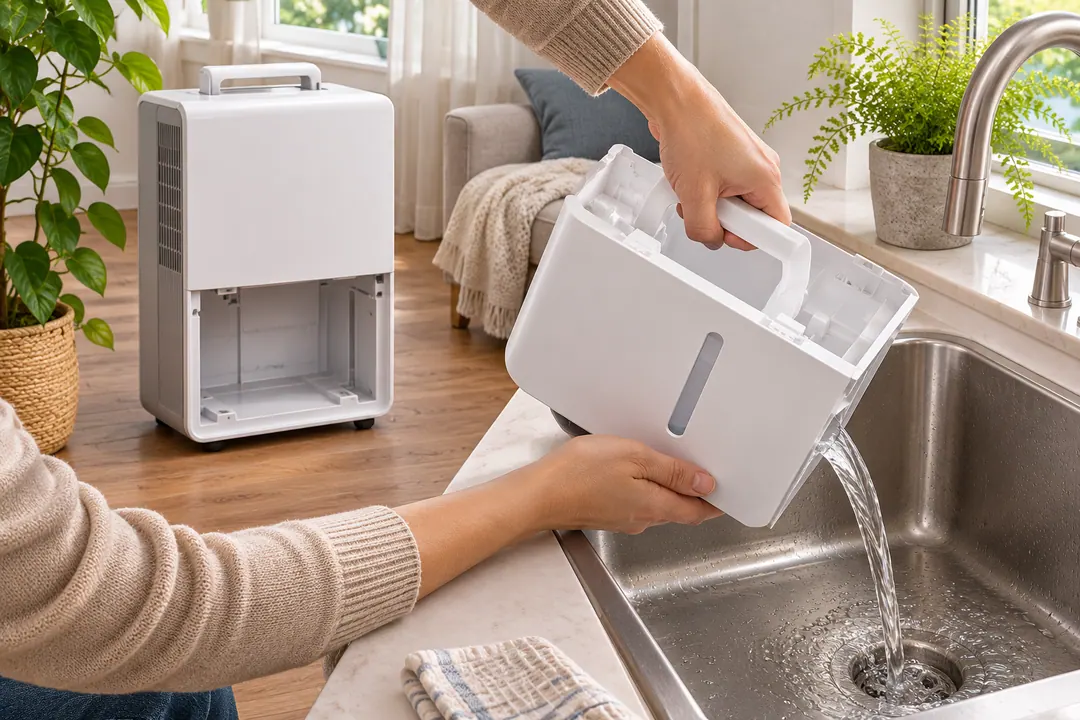
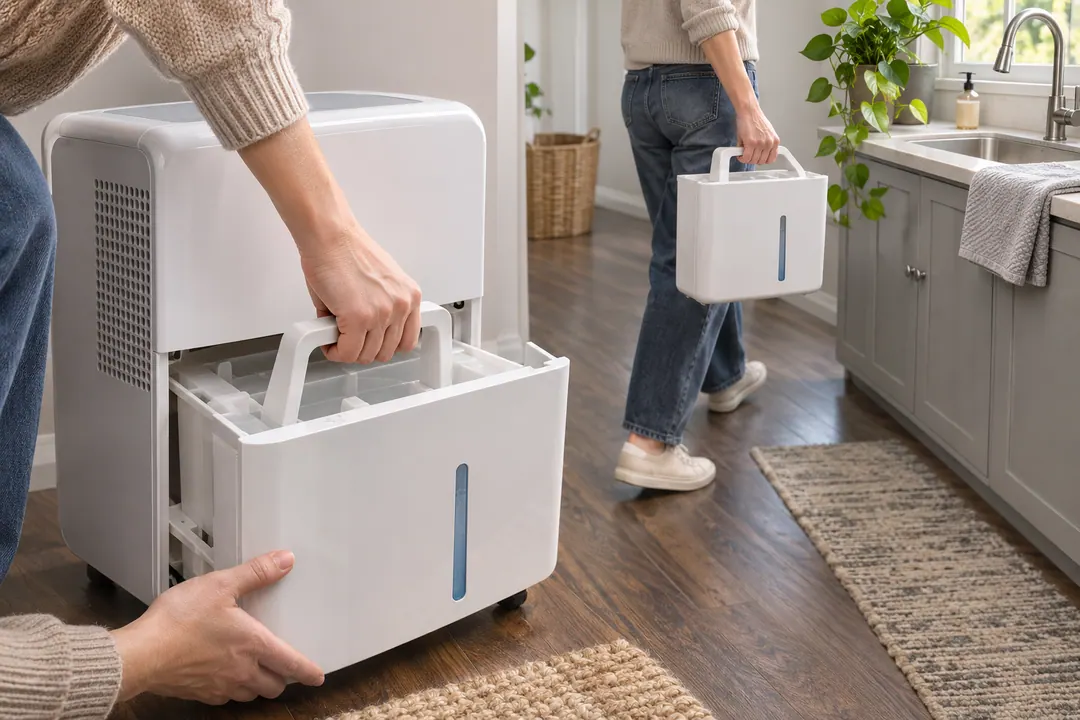
A 50-pint machine does not need a 50-pint bucket. A compact bucket may fill several times during a severe first-day recovery. Once full, most units stop until the bucket is emptied or drainage resumes.
That creates three different buying questions:
- Can the compressor remove moisture fast enough?
- Can the bucket or drain carry that water away?
- Can you live with the heat, noise, footprint, and maintenance?
The Midea Cube 50-pint model is a useful example: its high-capacity bucket changes emptying frequency, while the pump version changes where water can be sent. Neither feature changes what “50 pints per day” means.
Measure the room that shares air
Measure the area that is actually open to the machine. A basement split by closed doors is not one effective zone. A dehumidifier in the main room will have little influence on a shut closet without air circulation.
Also account for:
- Ceiling height above the usual eight feet
- Laundry drying or shower moisture
- Seasonal seepage
- Whether doors remain open
- Basement temperature
- A sump or drain route
Cool spaces can reduce real-world moisture removal and may trigger defrost cycles. Check the model’s operating-temperature range rather than treating the lab rating as guaranteed basement output.
A practical buying sequence
- Measure the connected floor area.
- Record relative humidity for several days with a separate hygrometer.
- Classify the worst untreated condition, not the best afternoon reading.
- Choose the modern pint band from area plus dampness.
- Decide how water leaves: bucket, downhill hose, or pump.
- Confirm the operating-temperature range.
- Compare ENERGY STAR efficiency using Integrated Energy Factor.
- Check filter access, clearance, and noise before buying.
Where a 50-pint machine makes sense
A current 50-pint model is the conservative portable choice for a large or persistently wet basement, especially when recovery load is high. It can be unnecessary in a mildly damp bedroom where a 20- or 30-pint machine is easier to place and quieter to run.
Do not size solely from a manufacturer’s maximum-square-foot headline. ENERGY STAR’s condition-based table is the more useful first filter because the same room can impose very different moisture loads.
Bottom line
Read pints per day as standardized removal capacity. Read bucket size as interruption frequency. Read pump or gravity drain as a plumbing constraint. A good purchase gets all three right.
What to buy
Each model below is on ENERGY STAR’s certified dehumidifier list, which also gives its tested capacity under the current procedure. Match the capacity to your band in the table above, then choose how the water leaves.
| Your band | Model | Tested capacity (ENERGY STAR) | Water route |
|---|---|---|---|
| 20–30 pints/day | Midea 22-pint dehumidifier, MAD22C1AWS | 22.3 pints/day | Bucket, or a hose on the built-in socket |
| 25–40 pints/day | Midea Cube 35-pint dehumidifier, MAD35S1QGR | 35.8 pints/day | Large bucket or included drain hose |
| 30–50+ pints/day | Midea Cube 50-pint dehumidifier, MAD50S1QWT | 49.7 pints/day | Large bucket or included drain hose |
| 30–50+ pints/day, water must go up or across the room | Midea 50-pint dehumidifier with pump, MAD50P1AWS | 49.7 pints/day | Built-in pump to a sink or window |
Before you choose a band, log the starting humidity for a few days with a separate hygrometer such as the Govee H5075 . Its listing says it stores two years of readings, so you can see the worst damp days, not just one afternoon.
The Cube 50 above has no pump. Midea sells the pump version of the Cube as MAD50PS1QWT; we found no Amazon listing for that exact model, so the pump pick is Midea’s non-Cube 50-pint pump unit.
Sources
- ENERGY STAR dehumidifier buying guidance
- ENERGY STAR explanation of the modern test and capacity change
- ENERGY STAR efficiency criteria
- ENERGY STAR certified dehumidifiers list (MAD22C1AWS, MAD35S1QGR, MAD50S1QWT and MAD50P1AWS capacities, checked October 25, 2026)
- Midea Cube 50-pint with built-in pump (MAD50PS1QWT)